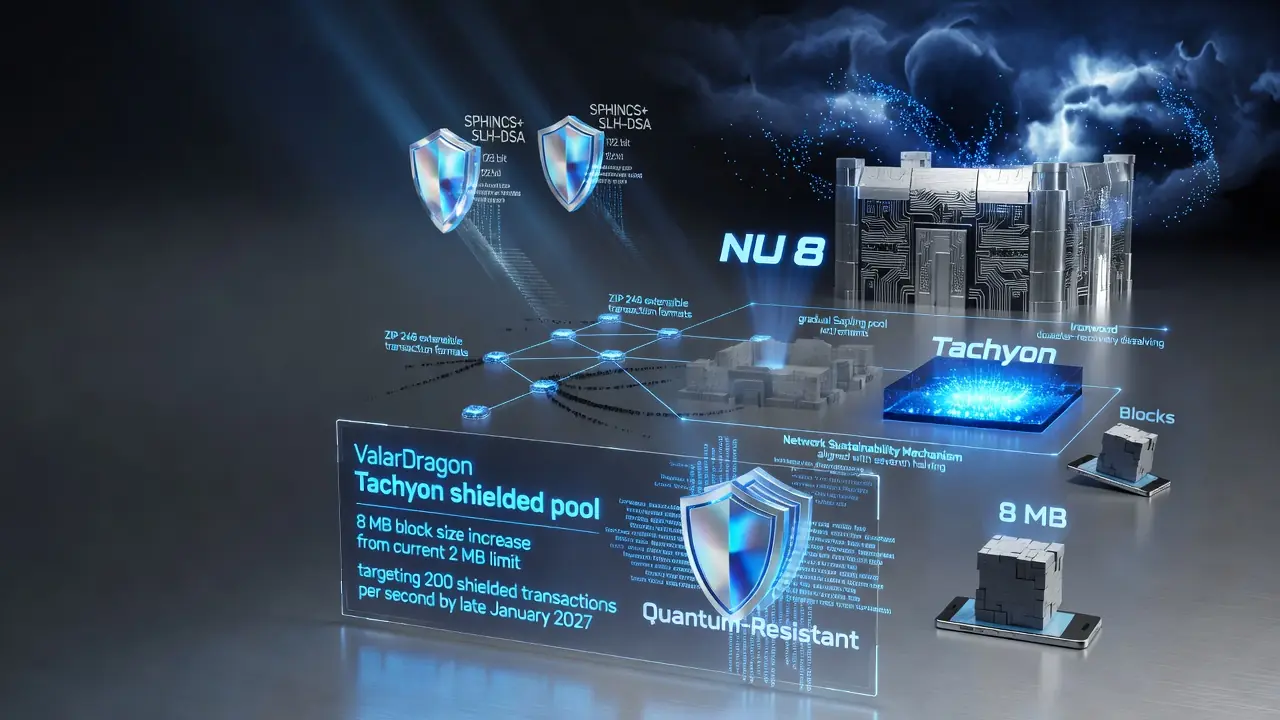
A Zcash community developer known as ValarDragon has outlined a proposed NU 8 network upgrade in an official forum post, targeting a late January 2027 window. The plan combines a new shielded transaction pool, a major block-size increase, and new cryptographic defenses against future quantum computing threats, though it remains in early discussion among core developers.
Bigger Blocks, Higher Throughput - and a Bandwidth Trade-off
The proposal's centerpiece is a new "Tachyon" shielded pool paired with an increase in the maximum block size from 2MB to 8MB, a fourfold jump intended to push shielded transaction throughput toward 200 transactions per second. That would mark a significant improvement over the performance limits that have historically constrained privacy-focused blockchains like Zcash.
The expansion goes well beyond an earlier community draft that proposed capping blocks at 3MB, making the new target roughly 2.67 times larger than that alternative. Core engineer str4d has pushed back, noting that technical specifications for out-of-band communication and private information retrieval - both needed by lightweight mobile wallets to sync efficiently - have not yet been finalized. Without them, an 8MB block size could burden phone-based wallets with heavier data loads, forcing a trade-off between raw throughput and accessibility for everyday users.
Layered Defense Against Quantum Computing
On the security side, the proposal sketches a two-track approach. The Tachyon shielded pool would rely on the ML-KEM key encapsulation mechanism to create what developers describe as unconditional post-quantum privacy, meaning that even a future quantum computer capable of breaking today's cryptography could not retroactively decrypt historical transaction data.
For transparent (non-shielded) addresses, the proposal would add support for SPHINCS-based signatures, specifically 128-bit and 192-bit SLH-DSA opcodes. This is meant to protect assets that have not moved into the shielded pool, along with the network's Ironwood disaster-recovery mechanism, from quantum-era attacks.
Transaction Format and Consensus Changes Under Debate
The proposal also recommends adopting ZIP 248, a specification meant to make the transaction format more extensible and to remove metadata fingerprints that hardware wallets currently expose when new shielded pools are added - a change aimed at closing off a method of tracking users through device-signature differences.
A more contentious element would eliminate the long-standing practice of changing the network's Consensus Branch ID with every upgrade, a step intended to reduce wallet compatibility problems after forks. str4d has warned that this identifier is a key safeguard against replay attacks across forked chains, and argues an alternative anti-replay mechanism must be in place before the practice is dropped.
Gradual Retirement of the Sapling Pool
Rather than imposing an immediate freeze - the approach taken with the older Sprout pool during the NU 7 upgrade - the new proposal would set a fixed future date after which the Sapling shielded pool stops accepting new deposits, while still allowing existing users to withdraw or transfer funds indefinitely. The plan would also shift a Network Sustainability Mechanism funding milestone to align with Zcash's seventh halving, delaying pressure on long-term network funding by an estimated four to eight years.
The proposal remains under open technical review on Zcash's community forum. Developers still need to resolve outstanding questions around light-client data retrieval and replay protection before the plan can move toward formal governance voting.